
The CSC Report Is Right, But Most People Will Read It Wrong
The CSC Report Is Right, But Most People Will Read It Wrong
The College Sports Commission just published the first official report on what college athletes are paid. It covers two things: revenue-share payments from schools and third-party Name, Image, and Likeness deals. The data is broken down by sport, position, and conference.
This is progress. But a source is only useful if you read it correctly. Most people won’t.
Why It Matters
By Friday, these numbers will show up in recruiting pitches, agent negotiations, brand budgets, and board presentations. Almost all of them will skip the section called “About the Data.” That section changes what the tables mean.
Five Things the Tables Don’t Say Out Loud
The NIL figures are not annual earnings. They are full contract values. A deal that runs two years counts once, at its full amount.
Athletes with no cleared deals are left out of the NIL tables. If you had zero deals, you are not in the data. So the “median” NIL athlete is the median among athletes who already had a deal, not the median athlete on the roster.
Football revenue-share numbers count promises as payments. If a contract says a player gets a bonus for making a bowl game, the report counts that bonus now, before the season is over.
Scholarships, cost-of-attendance stipends, and Alston payments are not included. The report understates total support.
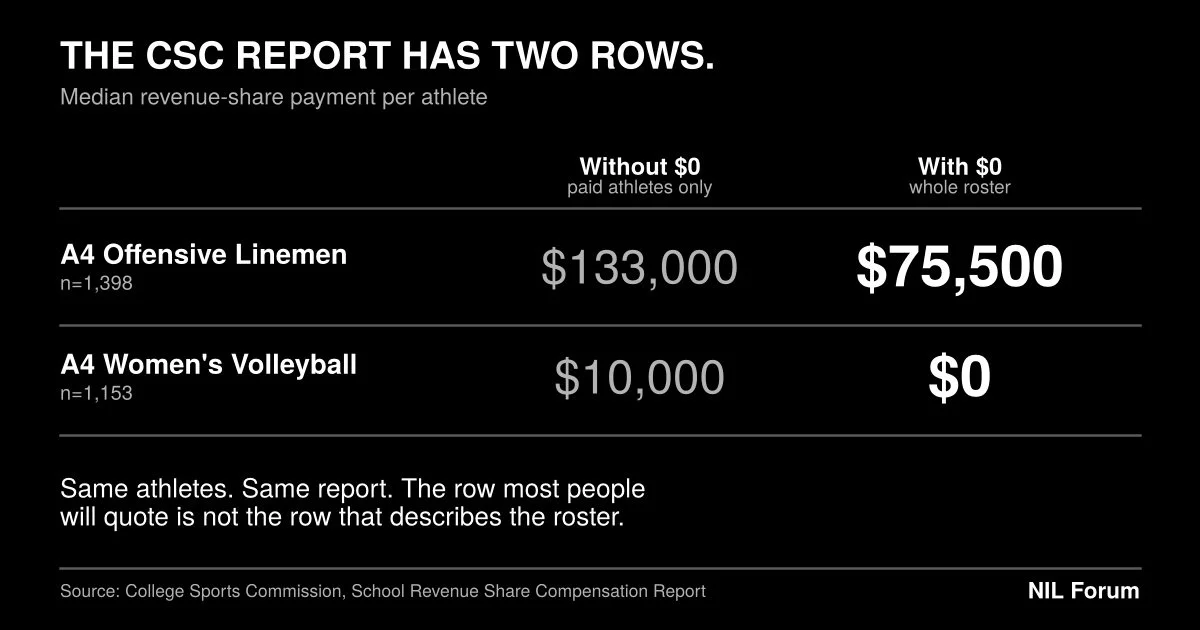
There are two rows on every revenue-share table, one labeled “With $0” and one labeled “Without $0.” Nearly everyone will quote the “Without $0” row.
The Number Everyone Will Miss
“Without $0” counts only athletes who received a revenue-share payment. “With $0” counts everyone on the roster, including athletes who got nothing.
That second row is the one that describes the real experience of a Division I athlete. Here is what it looks like.
Offensive linemen in the four autonomy conferences: 1,398 players. Count only the ones who got paid, and the median payment is $133,000. Count every player on the roster, and the median drops to $75,500. About 21% of A4 offensive linemen have no revenue-share payment at all.
Same position, outside the A4: 3,156 players. Among those who got paid, the median is $17,500. Among everyone, the median is $0. Roughly 69% of non-A4 offensive linemen are not in the revenue-share market.
Women’s volleyball in the A4: 1,153 players. Among those who got paid, the median is $10,000. Among everyone, the median is $0. About 60% of A4 volleyball players received nothing.
Same report. Same athletes. Two completely different stories depending on which row you read. And the “Without $0” row is the one that will get quoted.
What Athletes Expect
This is where the compensation data meets the data we collect every month from 5,000 college athletes.
Put that next to the “With $0” rows and the gap is obvious. A lot of athletes believe they are in a market they are not in. Nobody is lying to them. They are reading the “Without $0” row, like everyone else, and assuming the median applies to them.
For an administrator, that gap is a locker-room conversation waiting to happen. For an advisor or attorney, it is a client who has planned around money that isn’t coming. For a brand, it is a reminder that most of the roster is still waiting for its first real opportunity.
The Bottom Line
The CSC report is the best compensation data college sports has ever had. It is also easy to misread, and the misreadings will travel faster than the footnotes.
If you work in this space, read the “About the Data” section before you quote a single number. Then read the “With $0” row. That is where the athlete experience actually lives.
For NIL Forum members, this month’s briefing walks through the “With $0” gap position by position and crosses it with our segment data by sport and division. That part stays inside the Forum.
About the NIL Forum
The NIL Forum is the community for people to start, grow, or fix their NIL practice. Members get monthly expert briefings, proprietary research, courses, and office hours. https://www.nilforum.com/
Bill Carter, founder, teaches Name, Image, and Likeness at Boston College and has advised brands on athlete marketing for 25 years. He consults with Fortune 500 companies and 30+ Division I universities.