
Families Don't Understand the New NCAA Eligibility Rules
Why it matters
The NCAA just replaced its eligibility framework — and our preliminary research shows most high school prospect families are navigating it without a clear understanding of the rule, their own eligibility outcome, or how it might impact enrollment timing.
The rule, plainly
Starting this fall, Division I eligibility is no longer based on seasons of competition, redshirts, or waivers. It's based on age and enrollment timing. A student-athlete's five-year clock starts with whichever comes first — full-time college enrollment, or the academic year after their 19th birthday. Once it starts, it runs continuously. No pausing for injuries, transfers, or sitting out. Most waiver categories — medical hardship, delayed enrollment, extension-of-eligibility — are gone. Only two exceptions remain: military/religious service and pregnancy.
Stop calling it "5 for 5"
The NCAA has explicitly said calling this the "5-for-5" rule is inaccurate, and that distinction matters more than it sounds. Five years isn't guaranteed. Take reclassing — a common strategy where a high school athlete enrolls at a prep school and repeats a year to gain athletic and academic development, plus an extra cycle to get recruited. Families have used this move for over a decade with no eligibility downside. Under the new rule, a reclassified prospect who enrolls in college after the academic year following their 19th birthday will lose eligibility time — time that isn't just about competing, it's about being on campus long enough to potentially engage in NIL (building a following, partnering with local businesses, exploring genuine NIL opportunities.)
By the numbers — from our ongoing survey of 1,000+ high school prospects
This month, we asked families:
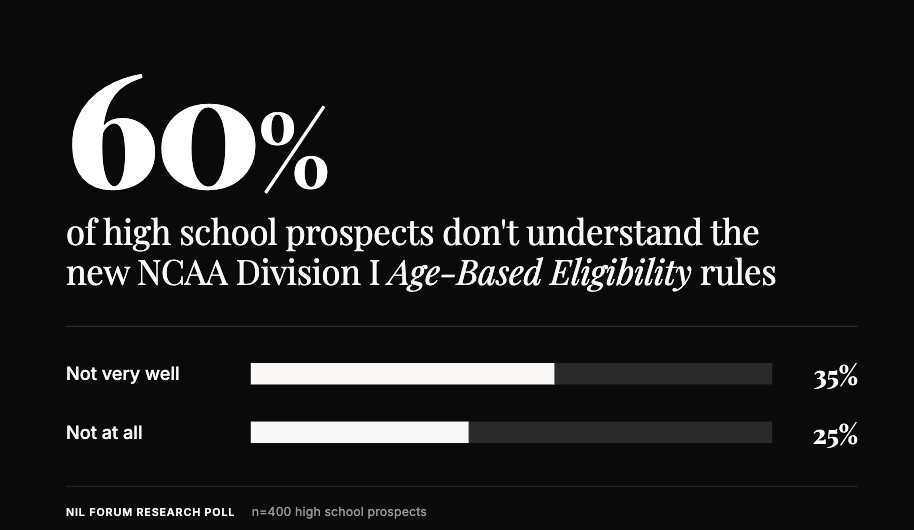
How well do you understand the new NCAA Division I Age-Based Eligibility Rules?
Very well: 12% | Somewhat well: 28% | Not very well: 35% | Not at all: 25%How confident are you that you know how many years of college eligibility you'll actually have?
Very confident: 18% | Somewhat confident: 31% | Not very confident: 29% | Not at all confident: 22%How much has the new eligibility rule affected your family's college enrollment planning?
A great deal: 9% | A moderate amount: 24% | A little: 33% | Not at all: 34%
Even prospects who say they "understand" the rule generally often aren't confident they know their own specific eligibility outcome. Understanding the concept and understanding your own number are two different things — and right now, most families have neither.
The bottom line
Families need support — and mostly don't have it. This is exactly where athletic administrators and professional service providers can step in and make a difference. The NIL Forum exists to help you do that: proprietary research like this, expert briefings each month (next: Erin Chaplin, Director, Altius Sports Partners — July 14), and a community of professionals doing this work every day. Learn more about NIL Forum membership.
About
The NIL Forum is the advantage for people making NIL decisions — providing monthly live speakers, proprietary data, and networking. NIL Forum Founder Bill Carter has advised brands on Name, Image, Likeness for 25 years — first in pro sports, now at the college level. He was the Co-Founder of the Gen Z sports agency Fuse, which he sold in 2019. In 2020, he founded Student-Athlete Insights and consults on NIL strategy with Fortune 500 companies and 30+ DI universities.