
The Portal Isn't the Problem

The Transfer Portal Isn't the Problem You Think It Is
More than 10,500 college football players entered the transfer portal during a 15-day window this past January. Men's basketball portal entries are expected to surpass 3,000 before the current window closes April 21. The White House signed an executive order about it. Nick Saban has made it his post-retirement cause.
Everyone agrees the transfer portal is broken, but few people are asking the right question about why.
Why it matters
Policy decisions are being built on the assumption that NIL created the transfer problem. The data suggests a more complicated truth: NIL didn't change why athletes leave. Rather, NIL continues to be one of many contributing factors.
By the numbers
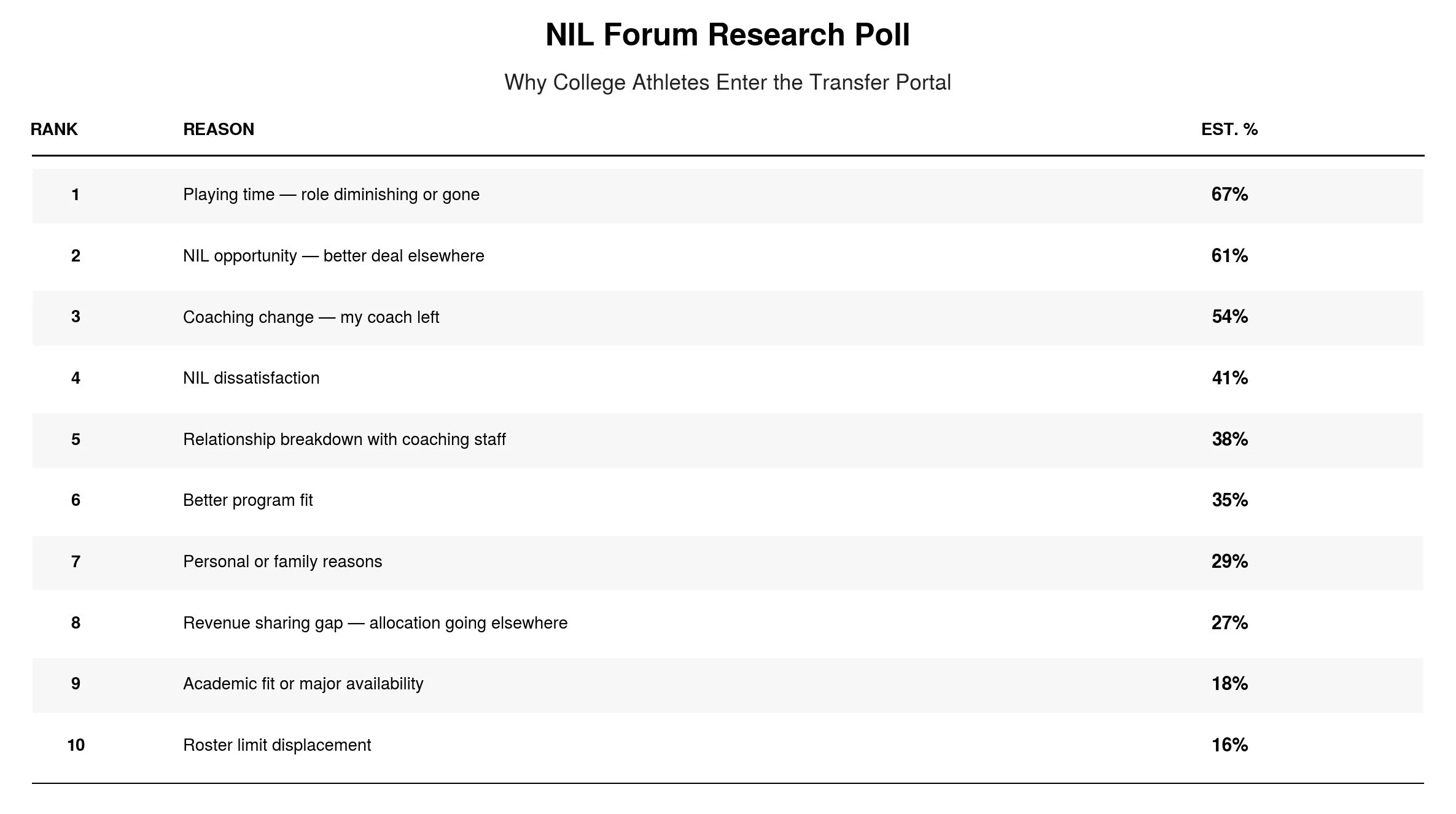
The NIL Forum Research Poll surveyed 1,060 college athletes who had entered the transfer portal — or seriously considered it — to identify their reasons.
Between the lines
Seven of the top ten reasons are traditional. They existed before NIL. They existed before the portal. NIL didn't invent the desire to leave. It created an additional incentive — and removed the penalty for doing so. Before 2021, an unhappy athlete had an emotional reason to transfer and a structural reason to stay. Today they have the emotional reason, a financial incentive, and zero sit-out requirement.
The bottom line
The transfer portal is a traditional-sports problem that NIL made impossible to ignore. Restricting transfers without addressing playing time, coaching accountability, and program fit is the policy equivalent of treating a symptom while the condition progresses.
About Bill Carter
Bill has advised brands on Name, Image, Likeness for 25 years—first in pro sports, now at the college level. He was the Co-Founder of the Gen Z sports agency Fuse, which he sold in 2019. In 2020, he founded Student-Athlete Insights and consults on NIL strategy with Fortune 500 companies and 30+ DI universities.
Thanks for reading! Please invite your friends to subscribe to NIL/edu.