
An 'Offer' Isn't What It Used to Be
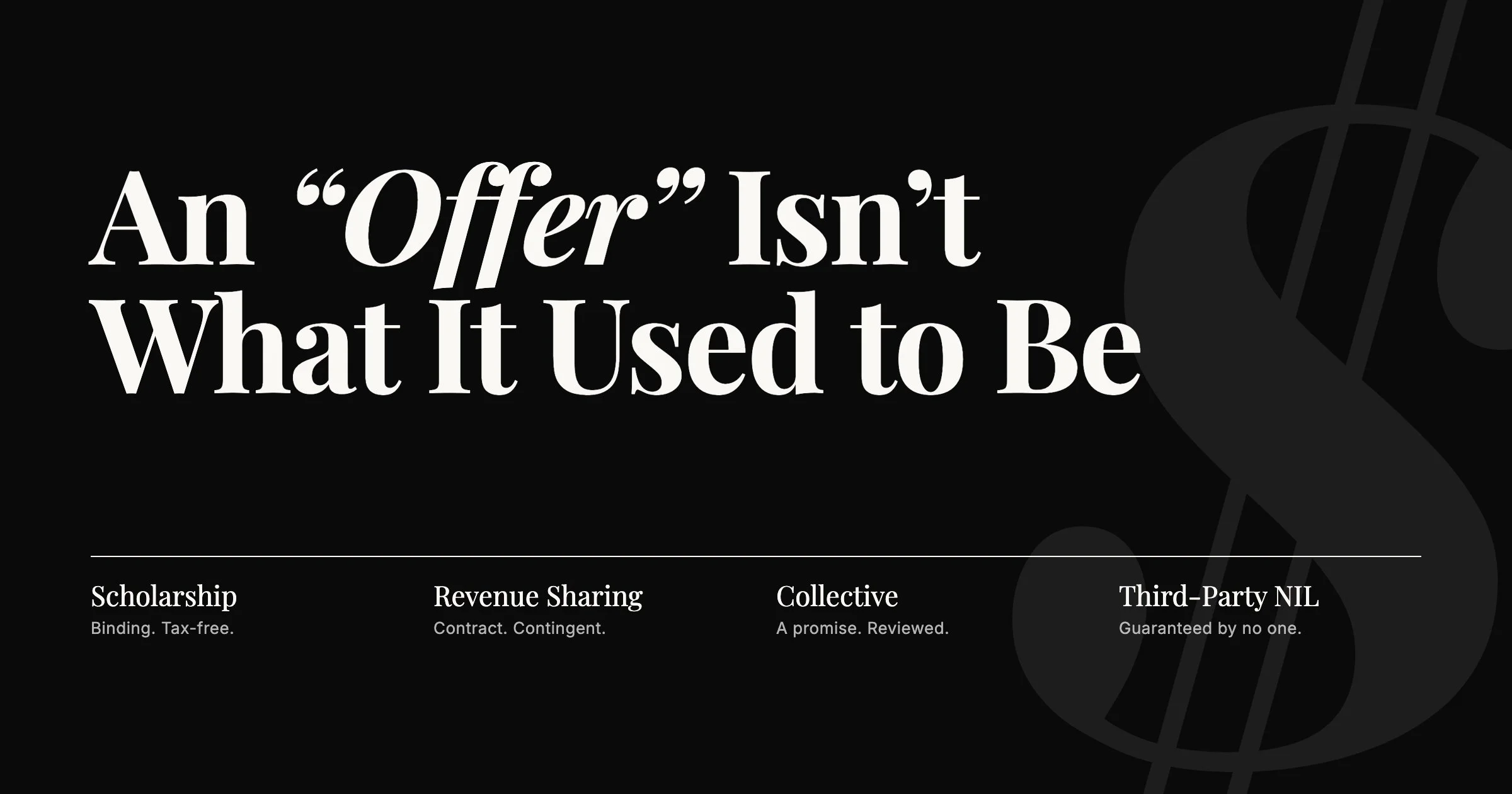
An 'Offer' Isn't What It Used to Be
I remind prospects and families that choosing a school should start with the pre-NIL era selection criteria: academic fit, team culture, and coaching. But with the growing importance — and growing confusion — around Name, Image, and Likeness and revenue sharing, families also need to understand what an "offer" on September 1 really means.
When a parent says, "Isn't the 'bottom line' number all that matters as long as it covers cost of attendance?", my answer is usually "no."
Why it matters
On September 1, coaches in many Division I sports can begin contacting the class of 2028. The offers mentioned on those calls now blend four sources: scholarships, revenue sharing, collective money, and third-party Name, Image, and Likeness deals. Families who treat them as interchangeable are comparing offers they don't fully understand.
First, the term itself
Cost of attendance is a federal financial aid figure, not an athletic one. Every school calculates it annually — tuition, fees, room, board, books, transportation, and personal expenses. It's the full sticker price of a year on campus.
When a coach says an offer "covers cost of attendance," the right question isn't "how much?" It's "with what?"
The four sources — and how they differ:
Guarantees. A scholarship is a binding aid agreement with institutional protections. Revenue sharing is a contract — contingent on enrollment and a roster spot, sometimes with transfer restrictions written in. Collective money is a promise from an organization the school doesn't control, now subject to deal review and fair-market-value scrutiny. Third-party NIL isn't guaranteed by anyone. A coach cannot legally promise the last two — and both can vanish mid-year.
Taxes. The one families miss most. Scholarship dollars for tuition, fees, and books are tax-free. Revenue sharing, collective payments, and NIL are ordinary income — often with no withholding, and frequently triggering self-employment tax. A $60,000 package covering a $60,000 cost of attendance leaves a family five figures short after taxes. Same number. Different money.
Obligations. Scholarships require eligibility. NIL and collective deals require work — appearances, content, deliverables. Revenue-sharing contracts can carry clauses most 16-year-olds have never seen. Nothing in this system is free money. The question is what each dollar demands in return.
Durability. Scholarships renew under established aid rules. NIL lasts as long as a brand's budget. Collective funding rises and falls with donor enthusiasm — and has already contracted at many schools since revenue sharing began. Revenue share follows roster decisions, and an injury or coaching change can reshuffle everything.
What to ask on every call
Which part of this is scholarship? Which part is revenue sharing, and what is it contingent on? Which part comes from a collective or third party the school doesn't control — and what's left after taxes?
The bottom line
"It covers cost of attendance" is only fully true for the scholarship portion. Everything else covers it maybe, this year, before taxes, if the student-athlete performs. Start with fit. But understand the money — because the families who do won't just pick better offers. They'll pick offers that are actually what they appear to be.
Go deeper
This is the kind of finding we dig into every month inside NIL Forum — start your membership for free, no credit card needed by responding "trial" to this email. For the next 30 days, you will access our next live expert briefing (Walker Jones, Grove Collective at Ole Miss), our new research report on August 7, office hours, and more.
About
The NIL Forum is the community for people making NIL decisions — providing monthly live speakers, proprietary data, and networking. NIL Forum Founder Bill Carter has advised brands on Name, Image, Likeness for 25 years — first in pro sports, now at the college level. He consults on NIL strategy with Fortune 500 companies and 30+ DI universities.