
The Secret to Developing an NIL Program, Service, or Product That Student-Athletes Want
Not a day goes by when I don’t recognize how fortunate I am to work with college coaches, Athletic Directors/Administrators, professional service providers (i.e. agents, attorneys, financial advisors), and sports organizations.
Each of these individuals are trying to serve student-athletes, but frequently, they fail to sell their solution to the student-athletes they are supporting on their NIL journey.
I teach at the business school at the University of Vermont and have taught at universities for 20+ years. I know that “sell” is a loaded word and makes some of you uncomfortable. You need to sell in order to be in a position to serve student-athletes.
In this week’s NIL/edu newsletter, I’m going to outline what you need to understand about student-athletes’ NIL challenges and aspirations. By understanding these, you will be better at selling your vision - the solution to get student-athletes past their challenges and closer to their goals.
One important point to remember before we get started: you’re not going to be able to help anyone with NIL who does not have an interest in NIL. Despite the cry of “NIL is for everyone,” it’s really not. I speak on campuses all the time that spare no expense in supporting their student-athletes’ NIL dreams - and some of those campuses still have less than 50% of their athletes pursuing NIL. NIL is awesome for many, but it’s not for everyone.
But assuming that you have student-athletes who want to pursue NIL, your focus on their challenges and aspirations will make you much more effective in serving them. You will become more capable of showing student-athletes how your program, service, or product can help them close the gap between the NIL challenges they face today and their future NIL success.
The Most Common NIL Challenges
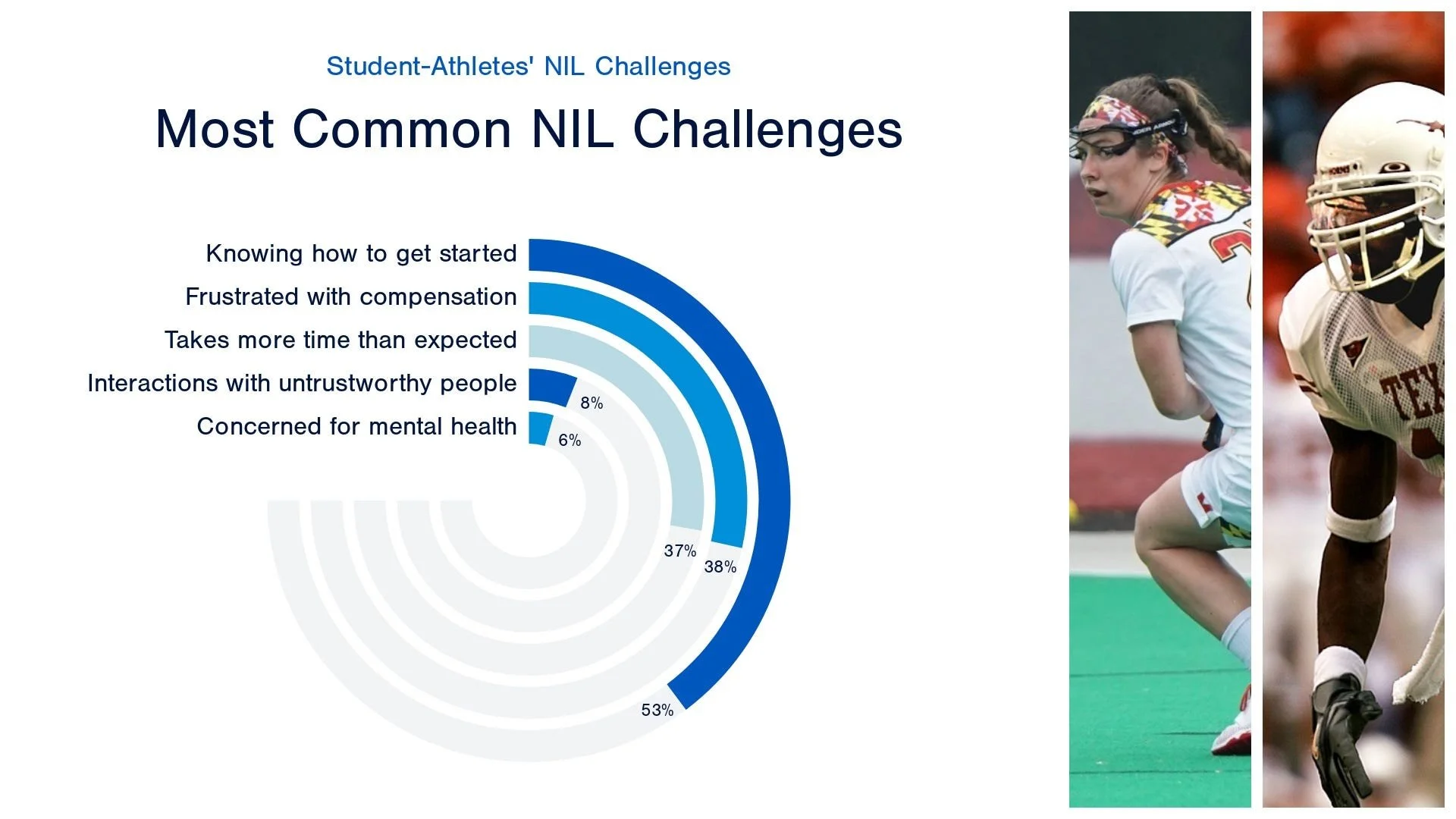
Based on numerous NIL Research Poll surveys I’ve conducted (1,000+ participants in December 2023 and February 2024), the most common NIL challenges for student-athletes include:
(1) Not knowing how to get started with NIL;
(2) Growing frustrated because of a perceived lack of successes;
(3) NIL taking more time than expected;
(4) Interaction with untrustworthy people;
(5) Mental health concerns.
One of the issues I see is that student-athletes and those who serve them are often speaking different languages - or at least using different dialects.
When student-athletes are asked to describe their NIL challenges, they describe day-to-day, real world examples (see the graph above.) While we, the adults who serve them, tend to describe our “solutions” in broad terms.
I’m as guilty as anyone.
Student-Athletes say NIL activities take too much time ; my response is education on time management inside a module on “professional development.” Student-Athletes say they don’t know where to begin with NIL; my response on how to get started in NIL is in a module called “NIL Deal Literacy.”
I’m not exactly wrong to approach NIL education with broader themes, but I probably don’t do myself any favors by merchandising my programs like this. I suspect you do the same thing with your program, service, or product.
I’m not suggesting that you entirely revise your program, service, or product to only use the language of student-athletes, but I want to make you aware that using yourterms and not their terms will result it you needing to further explain what NIL challenge your program, service, or product will actually solve.
So let’s say you’re an AD looking to grow your NIL program and engage more student-athletes. Because you read this newsletter 😀, you know that many of your athletes are frustrated because of their perceived lack of financial successes.
So you might want to educate your student-athletes with real and comparable NIL compensation data. You will want to describe the NIL media headlines as mostly focused on the top 1% of NIL athlete earners, which in turn results in a kind of misinformation about what the average student-athlete earns.
Lastly, while I hope my data is a good resources for you, if possible, you should access student-athletes directly. They’ll be your best source of information. You should ask them (in one-on-one interviews, small group focus groups, or surveys) what their NIL challenges are. Then develop your program, product, or service around those problems.
Never lose site of the emotions being felt by student-athletes: They feel stuck and you will help them get un-stuck!
The NIL Aspirations of Student-Athletes
Once you understand the main NIL challenges faced by student-athletes, you’ll need to become familiar with their goals and aspirations.
This will allow you to talk about framing your program, service, or product in a way that student-athletes can see will have a positive impact on their NIL future…
When I survey student-athletes about their NIL aspirations, I try to understand what specific NIL goals they want to achieve and why they want to achieve them. Understanding their aspirations allows me to improve my products/services and describe them in a way that shows their positive impact.
I can’t stress this enough: you need to speak directly to the desired future (aka aspirations) that student-athletes want.
Let’s use the example again of the Athletic Director looking to engage more student-athletes in their NIL program.
The aspirations of student-athletes include:
(1) Financial gain
(2) Networking
(3) Professional development
(4) Personal brand development
(5) Community involvement
In responding to these aspirations, if I were that AD, I’d talk about my NIL program on social media, email marketing, and website like this:
“Earning income is important to you, so our NIL program includes ‘how to’ training to identify NIL deals and manage your finances.”
“A genuine personal brand is a career tool that last a lifetime; our NIL program takes you through a proven process and results in a personal brand that will help you land NIL deals today and position yourself to start your career.”
“For student-athletes who want to make community involvement a focus of their NIL efforts, our program outlines how to identify nonprofits that align with your values.”
A brand marketing “hack” that I recommend to to uncover your student-athletes’ aspirations is to talk to some student-athletes who haven’t yet engaged with your program, service, or product.
By asking non-users about aspirations, you are likely to get information about their internal motivations, which can provide you with additional insights for your program and how to speak about it.
Open-ended questions like these can be helpful:
“What would be different about your life on-campus or after graduation if you participated in NIL?”
“If you did pursue NIL, what would be the first thing you’d want to do?”
“What might motivate you to pursue NIL?”
Remember, the goal of your pitch is to describe your program, service, or product in a way that addresses how their present problems can be solved and what their future looks like.
About Bill Carter
Bill has advised brands on Name, Image, Likeness for 25 years—first in pro sports, now at the college level. He was the Co-Founder of the Gen Z sports agency Fuse, which he sold in 2019. In 2020, he founded Student-Athlete Insights and consults on NIL strategy with Fortune 500 companies and 30+ DI universities. Read more about Student-Athlete Insights.